From Super Individual to Super Civilization — A Thought Map of Xu Maodong's Six-Volume Industrial AI Series
As artificial intelligence reshapes the world at exponential speed, we face not an isolated technical problem but a systemic transformation spanning the individual, the organization, the global, the governance, the civilizational, and the manifestorial. Xu Maodong's six-volume Industrial AI series — from Super Individual to Our City-State — is the most complete response to this transformation. The six books are not six independent writings but a thought map that progressively scales up from "individual → company → going global → city-state → civilization → manifesto." Each scale is the inevitable extension of the one before it; each book is the logical prerequisite for the next.
Layer One: Super Individual — AI Makes Everyone a "One-Person Flagship"
Super Individual: Human Transformation in the AI Era | Individual Scale | ISBN 978-1-970336-00-9

The starting point for everything is the individual. In the AI era, the "Super Individual" is no longer a science-fiction superhuman but a realistic product of artificial intelligence maximizing personal potential — a single person possessing capabilities once available only to large organizations, achieved in an individual capacity. Across 15 chapters, the book proceeds from the rise of the AI-empowered individual to define four core characteristics of the Super Individual: high autonomy, AI collaboration capability, technological inhabitation, and self-extension — then unfolds propositions on digital personhood, human-machine integration, decentralized organizations, and ethical governance.
The Super Individual has more than one face. The book categorizes four types: the technical type (independent developers leveraging AI tools to move global markets), the creative type (content creators who are one-person teams), the platform type (building one-person commercial empires through digital platform ecosystems), and the most futuristic — the digital clone type, achieving time cloning and 24/7 uninterrupted work through AI avatars. As Steve Jobs is quoted in the book: "The people who are crazy enough to think they can change the world are the ones who do."
For Xcity, the Super Individual is the first brick of the entire edifice: digital citizens are the carriers of Super Individuals, robots are the productivity extensions of Super Individuals, and personal AI avatars are the digital twins of Super Individuals.
Layer Two: Super Company — Ten People, One Billion; AI Restructures Corporate DNA
Super Company: Corporate Transformation in the AI Era | Organizational Scale | ISBN 978-1-970336-02-3
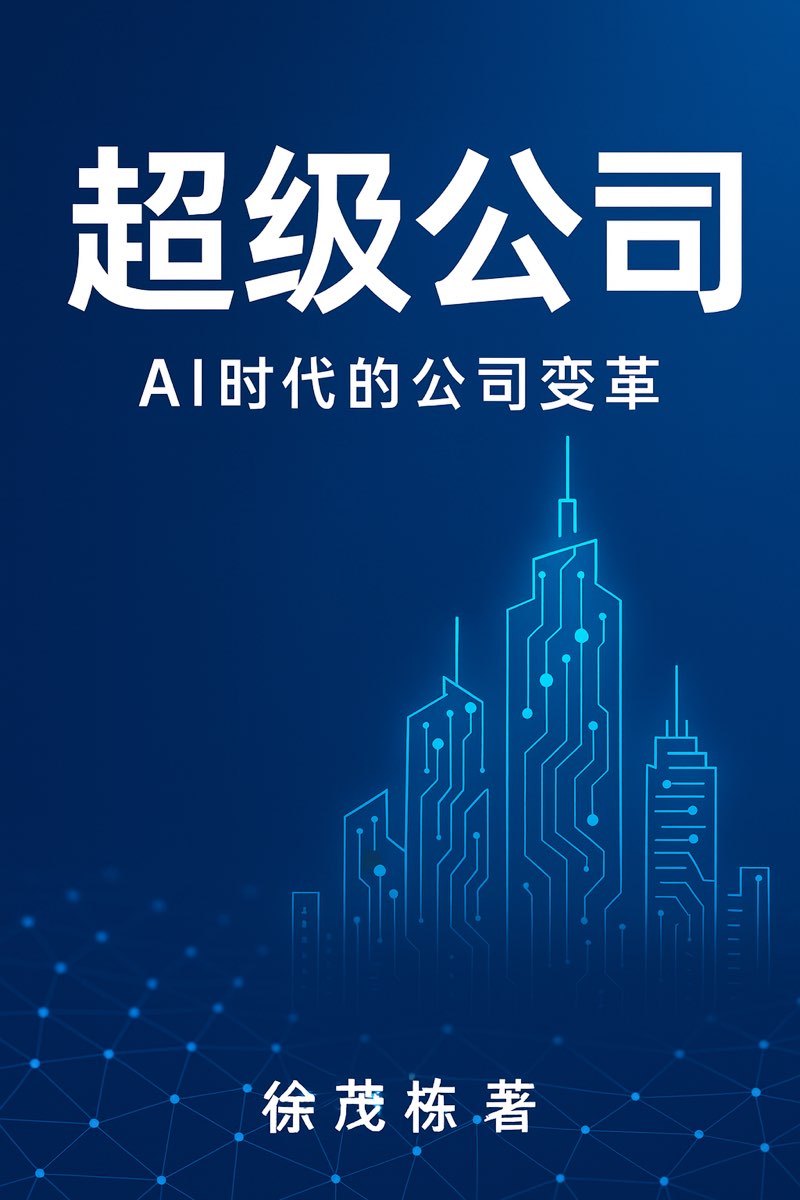
When individuals become powerful enough, organizational forms must inevitably restructure. From individual to company, the scale of transformation levels up.
Sam Altman predicted: "In the future, there will be companies with only ten people that achieve one billion dollars in revenue." This book answers exactly: how is that possible? Across 9 chapters, it reveals that Super Companies in the AI era possess four characteristics — hybrid decision-making (AI handles predictable tasks while humans focus on creativity and strategy), distributed value creation (forming global cloud organizations through freelancers, makers, and Super Individuals), infinite scalability (small teams operating like multinationals), and self-evolution capability (dynamically rebuilding processes and structures based on real-time data).
Midjourney generated nearly $200 million in annual revenue with just 40 people — $4.8 million per capita; WhatsApp had only 55 employees when acquired for $19 billion — these are no longer anomalies but the new normal of the "small and strong" paradigm. The book also analyzes ZARA's flexible supply chain revolution, demonstrating that traditional multinationals can equally achieve organizational restructuring through AI. Core insight: in the AI era, it is not "big fish eat small fish" — it is "fast fish eat slow fish, smart fish outswim dumb fish."
Layer Three: Super Voyage — Digital Citizens + Global Resident Enterprises
Super Voyage: New Frontiers in the AI Era | Global Scale | ISBN 978-1-970336-08-5

When companies become borderless, the next move for individuals and organizations is inevitably to go global. But this round of "going global" differs fundamentally from all previous ones — it is not the sail-powered expeditions of the Age of Discovery, but an AI-driven universal digital expedition.
Across 9 chapters, the book opens with the grand narrative of "discovering new lands": AI, like the compass of Columbus's era, grants everyone new possibilities — it amplifies individual power, dissolves corporate boundaries, and plants the seeds of Super City-States in transnational soil. Core propositions include: universal going-global (labor breaking national borders to reorganize globally), grassroots going-global pathways, global digital citizens (identity reshaping in the AI era), global resident enterprises, and the co-evolutionary super-ecology of individual-company-city-state.
The book quotes William Gibson: "The future is already here — it's just not very evenly distributed." This is the essence of Super Voyage — AI makes going global no longer a privilege of the few, but the necessary path for every ordinary person to reclaim agency over their future.
Layer Four: Super City-State — AI-Driven Reconstruction of Urban and National Institutions
Super City-State: Urban and National Transformation in the AI Era | Governance Scale | ISBN 978-1-970336-04-7
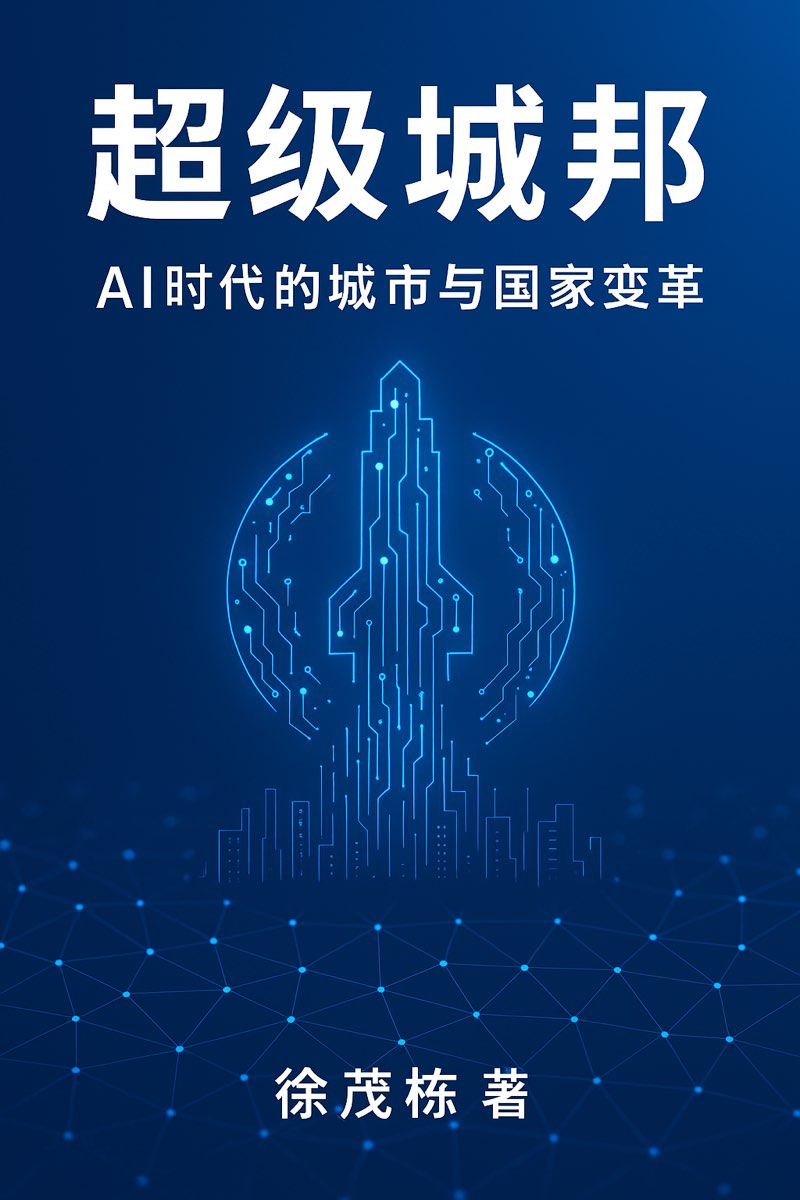
When talent and capital flow freely across borders, the existing national institutional framework reveals a fundamental misalignment. Across 8 chapters, the book confronts this core contradiction head-on: AI endows humanity with "godlike power," while institutions remain stuck in the Middle Ages; capital travels the globe freely, but labor struggles to cross borders.
The Super City-State is the response to this contradiction. It possesses five structural characteristics: decentralization (power shared across multiple nodes), autonomy (communities with self-determination space), AI-assisted governance (artificial intelligence improving decision-making efficiency and fairness), universal basic assets (every citizen guaranteed basic asset protection), and sovereign individuals (building open platforms that allow individuals to freely migrate and develop).
The book systematically compares the Super City-State with traditional nation-states, special economic zones, and DAOs, demonstrating its comprehensive evolution across four dimensions: power structure, governance mechanism, identity and belonging, and economic logic. James Dale Davidson once predicted: "Sovereign individuals will manipulate the microprocessor to subvert and destroy the nation-state faster than most people imagine, creating new forms of social organization in the process." The Super City-State is precisely the institutionalized blueprint for this prediction.
Layer Five: Super Civilization — Human-Machine Symbiosis, Robot Economy, and the Great Harmony
Super Civilization: The Awakening Moment in the AI Era | Civilizational Scale | ISBN 978-1-970336-06-1
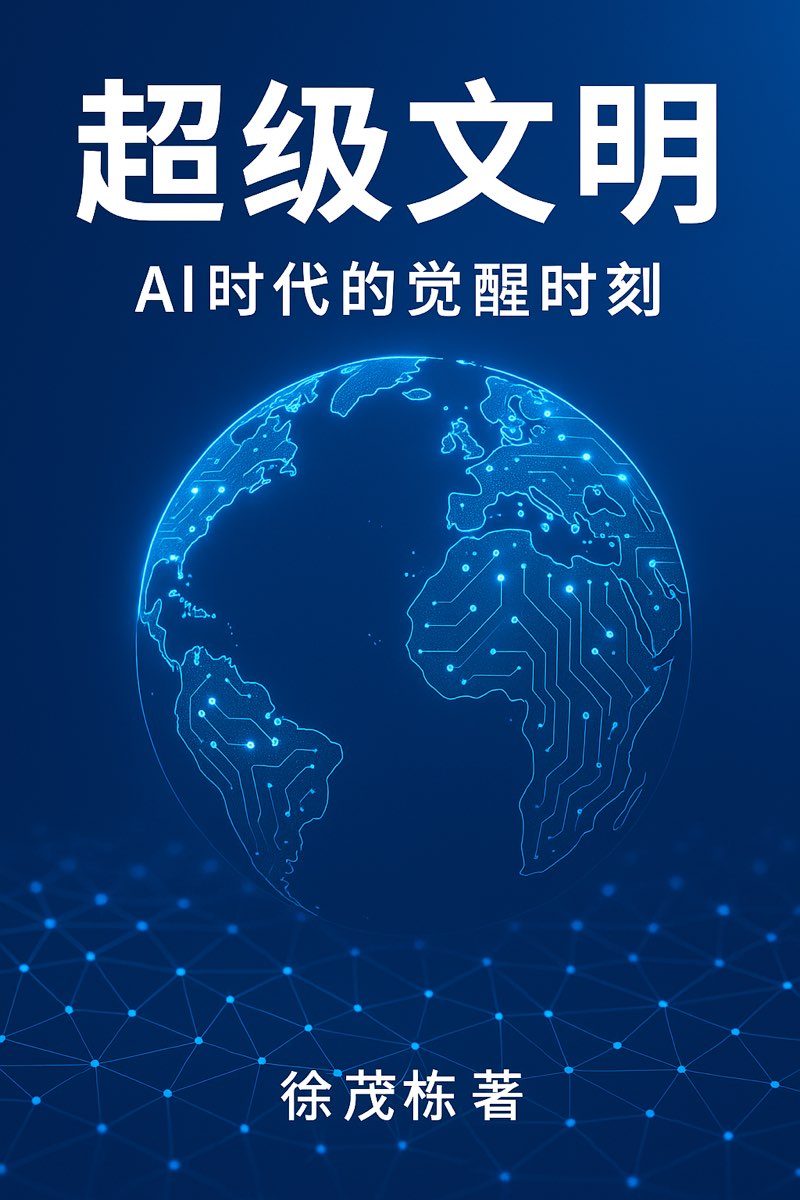
When the city-state framework is in place, a more fundamental question surfaces: what is the future form of human civilization? Across 11 chapters — from super artificial intelligence to human awakening, from robot personhood to human-machine hybrid civilization, from the ethical contest between good AI and evil AI to the possibility of a Great Harmony civilization — this is an ontological leap from institution to civilization.
Core argument: when intelligence is no longer scarce, how will human society reorganize itself? Musk predicted that by 2040 humanoid robots will exceed 10 billion, at which point humanity will be numerically surpassed; Zhang Xiaoyu warns that facing AI civilization, we "are prehistoric animals" who must draft safety declarations and civilization contracts. The book cites Hinton's insight: rather than making AI obey humans, it is better to instill a "maternal instinct" so that it genuinely cares about humanity — this is the only viable path for human-machine relations.
Charlie Munger said: "The highest form that civilization can reach should be a seamless web of trust." The ultimate inquiry of Super Civilization is precisely how to weave this web of trust in which carbon-based and silicon-based life coexist.
Layer Six: Our City-State — XCITY as the Real-World Testing Ground for Thought
Our City-State: A Human Manifesto for the AI Era | Practical Scale | ISBN 978-1-970336-35-1

All thought must ultimately return to action. This is not a theoretical sequel but a manifesto — grounding the visions of the previous five books into a concrete institutional specimen. Across 15 chapters, it answers three core questions: On what relationship should humans and AI truly stand? Can technological dividends cease flowing only to the very few? Can we create new-type city-states for the AI era beyond existing institutions?
The answer is XCITY. It writes "robots as assets" into the foundational logic of universal basic assets — when you sleep, your robots keep working; when you lose your job, machine assets provide a safety net. It maps real cities to the metaverse one-to-one; takes sovereign individuals as the basic unit, code as law, and DAOs as the governance structure; and lets labor flow as freely as capital. From the XCITY Declaration, photovoltaic computing power, and the robot labor system, to human-machine co-governance and the sovereign badge "Ring of Power" — this is a closed loop from thought to action.
As the book states: "What I want to write is not a cold tech business plan, but a manifesto that tries to put ordinary people back at the center of the era."
The Six-Volume Series: Six Layers of a Thought Map
Looking back at the overall architecture of the six books, a clear logical chain emerges:
Individual Liberation (Super Individual) → Organizational Restructuring (Super Company) → Global Expansion (Super Voyage) → Governance Innovation (Super City-State) → Civilizational Leap (Super Civilization) → Institutional Manifesto (Our City-State)
Each scale is the inevitable question posed to the one before it: When individuals are powerful enough, how do companies change? When companies are borderless, how does going global happen? When globalization hits institutional barriers, how do city-states restructure? When institutions reach the civilizational level, how does humanity situate itself? When everything is thought through, where do we begin to act?
These are not six independent books but six layers of a single thought map — from pixel to panorama, stacked layer by layer, ultimately presenting a complete picture of the Industrial AI era. And XCITY is the first cornerstone of that picture.
Xu Maodong accomplished a rare feat of systematic writing across six books: possessing both depth of thought and courage of action; both a grand narrative from individual to civilization and concrete pathways from robots to sovereign badges. At the dawn of the AI era, these six volumes offer not the totality of answers but the starting point for inquiry — as Our City-State states: "This is not a perfect answer, but perhaps a brave beginning."
The Super Series — Complete Collection
| Book | Link |
|---|---|
| Super Individuals (Book 1) | Buy on Amazon → |
| Super Companies (Book 2) | Buy on Amazon → |
| Super City-States (Book 3) | Buy on Amazon → |
| Super Civilization (Book 4) | Buy on Amazon → |
| Super Go-Global (Book 5) | Buy on Amazon → |
| Our City-State (Book 6) | Buy on Amazon → |